The cedar of Lebanon is not the densest forest, but it may be the most written and symbolic. From ancient cuneiform to the Bible, Sumerian epics, Phoenician merchant ships, to contemporary national flags, the cedar has always existed in the human imagination as a “tree of culture.”
This is not a forest for people to get lost in, but the backbone of civilization to “stand up”.
Trees are noble and never creep
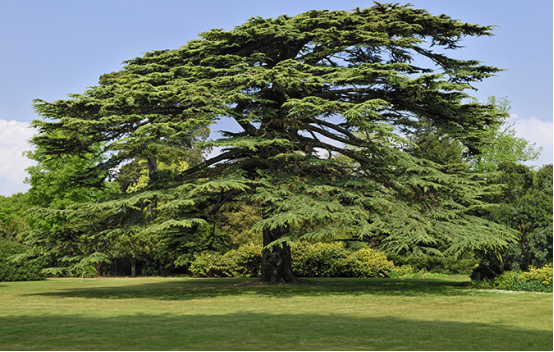
The cedars of Lebanon mostly grow on the highlands, seemingly overlooking the plains. Unlike the trees in the rainforest, they do not crisscross each other, but stand tall and straight, keeping their distance, like a team of silent guards.
Their nobility lies not in visual decoration but in the dignity of their material: fine-grained wood, hard texture, and resistance to corrosion. In ancient times, this was the most sought-after resource. Assyrian kings launched expeditions for it, Egyptian pharaohs paid tribute, King Solomon built temples for it, and the Phoenicians built ships for it.
This is a tree that has been entrusted with a historical mission: it never bends and does not rot easily.

The cultural status of forests
Here, the role of the forest has long transcended ecological significance. The Lebanese cedar is not merely “alive”; it participates in human language, architecture, and religion, having been pulled from “forest” into “symbol.”
In the Epic of Gilgamesh, the hero journeys into the cedar forest, fells the giant trees, and slays the guardian god, Humbaba. This myth embodies humanity’s challenge to nature and its seizure of divine substance. Countless civilizations have since repeated this process: felling, building, recording, and then felling again.
It could be said that the cedars of Lebanon were the first forest to be systematically conquered by civilization—and this foreshadowed the tragedy of the forest.
Warnings in Mythology
However, behind these praises and constructions, ancient myths also left behind laments for cedar forests. In Gilgamesh, cutting down cedars brought the wrath of the gods; in the Bible, cedars symbolize pride, and tall trees will eventually be cut down.
This is a reflection within civilization: we cut down cedars and use them to build temples, ships, and monuments, but we also realize that this “support” comes at a price. The forest is not a silent substance; it also has a destiny.
Today, this reflection has become even more urgent. Lebanon’s cedar forests are no longer vast, and some of them remain only in protected areas at high altitudes. In the sunlight, they still stand tall, but they appear even more lonely.
National symbol: The political identity of a tree
The Lebanese flag features a green cedar tree at its center. It is not a randomly chosen totem, but a symbol of the country’s identity: steadfast, enduring, and standing tall through the ages.
But precisely because of this, it is often used to remind people of the fragility of a country: when corruption, war, and external erosion come like felling, how long can a cedar tree last? In a modern country, the significance of a tree is no longer ecological, but moral.
Conclusion: Echoes of Civilization in the Forest
In the cedars of Lebanon, we read about the forest’s secondary identity: no longer simply a natural site, but also a vehicle and evidence of civilization. We cannot define the forest simply by its greenness; we must also understand its cultural significance.
This is not just a story about Lebanon, it’s about all forests: they are not only ecological refuges, but have also been inspiration for words, symbols of power, pillars of architecture, and sources of disaster.