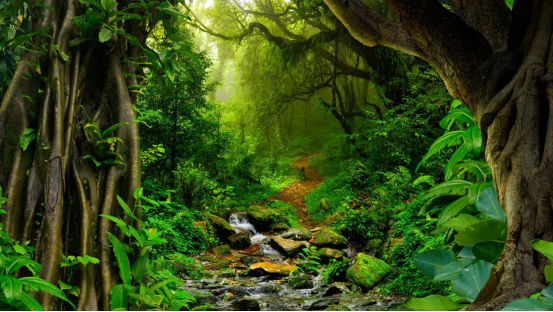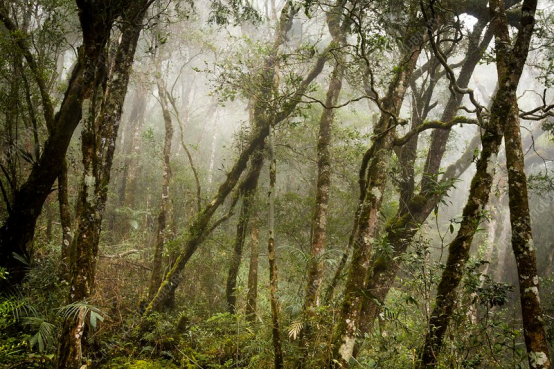
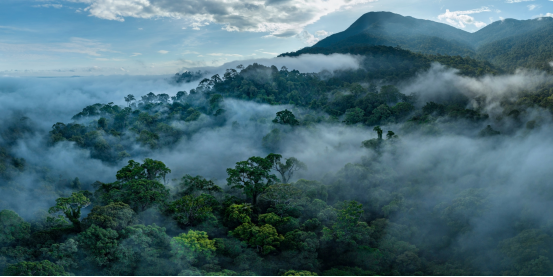
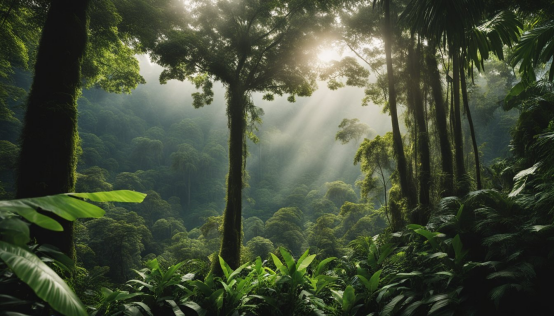
The clouds don’t fall from the sky, but rise from between the leaves. In the highland rainforests of Borneo, locals call this forest “the fog of life,” meaning that only living things can create such a dense, gentle, and inescapable white.
At an altitude of over 2,000 meters, the air is as damp as cotton, and the light is thin but not cold. This is not the glory of heaven, but the tranquility of another world.
Suspended life forms
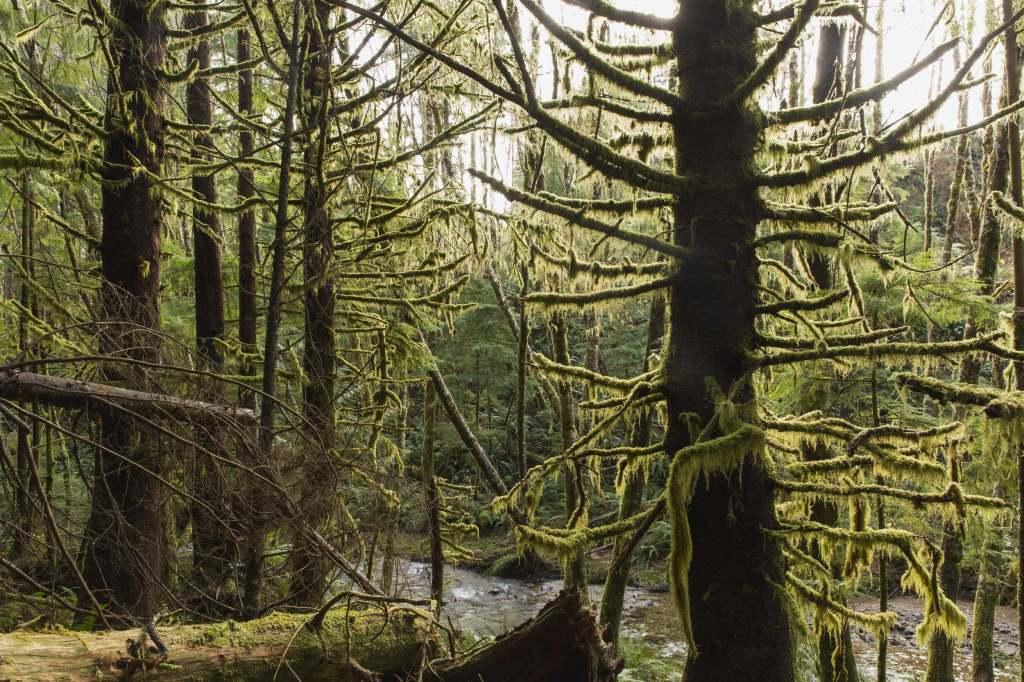
In this forest, trees don’t grow from the ground; instead, they cling to one another, layer upon layer. It’s difficult to distinguish a tree’s roots, trunk, and branches; they function as a single, integrated structure, each supporting the other. Vines and ferns wrap tightly around the trunks, while the humidity in the air allows mosses to grow freely in mid-air. The true “ground” is actually created in the air.
Most astonishing is the collaborative relationship between plants and the air: every orchid, every lichen, every leaf here extracts water, nitrogen, and life from the air. Roots are no longer bound to the ground, but have become adsorption systems. This isn’t plant degeneration, but an evolutionary art of survival in the clouds.
Time slows down
Walking into this forest, time becomes dense. The fog narrows the view, and the refracted light makes everything seem like slow motion. You’ll see raindrops not falling, but pausing in the air before being gently caught by a leaf.
The sounds also softened. Footsteps, breathing, even birdsong, seemed to be tuned into a “bass reverb.” There were no clear echoes, only a damp resonance.
This environment doesn’t urge you to explore, but rather invites you to stop. You’ll find that movement is a disturbance, while stillness allows you to feel the forest’s vitality. The stiller you are, the more alive it becomes.
Unnamed species
Borneo’s cloud forests boast one of the highest species densities in the world—particularly in microorganisms and fungi. Scientists still discover new species annually, but many are lost to habitat loss before they have a chance to be named.
The creatures here don’t exist for human sight. Their colors aren’t vibrant, their forms asymmetrical. You’ll find a frog so small it’s almost transparent, an orchid that floats like a feather, and a slime mold that spores only at dawn. They seem more like byproducts of the climate than protagonists of life.
But it is these tiny, fragile, and short-lived lives that maintain the overall structure of the forest. If the Amazon is a symphony of life, this is the hum of life in the humidity.
Dependence on “height”
The survival of Borneo’s cloud forests depends on a delicate balance of altitude, humidity, and microclimate. At even lower altitudes, the forest reverts to a tropical rainforest; at higher altitudes, it enters a tundra state. This “caught-in-the-gap ecosystem” is exceptionally sensitive; even the slightest increase in temperature or decrease in precipitation could lead to the collapse of the entire ecosystem.
Therefore, it is more fragile and mysterious than other forests. It does not emphasize strength and eternity, but rather constructs itself with “temporariness” and “lightness.” This is not a flaw, but another form of wisdom.
In conclusion: Get closer with a light touch
We’re used to exploring nature on foot, but Borneo’s cloud forests lend themselves to being approached with breath. These forests teach us that not all of nature can be conquered or understood. It doesn’t require participation, only respect.
This forest doesn’t exist for humans, but it plays an irreplaceable role in maintaining the planet’s balance. When we finally understand that “lightness” is also a form of power, perhaps we can understand the meaning of this forest—it doesn’t make a fuss, doesn’t declare, doesn’t resist, it simply quietly “is,” and that’s enough.
In the next article, we’ll travel to the Black Forest: Germany’s mythical forest . It’s a forest tucked away in fairy tales, and a borderland of irrationality left behind by a rational nation.