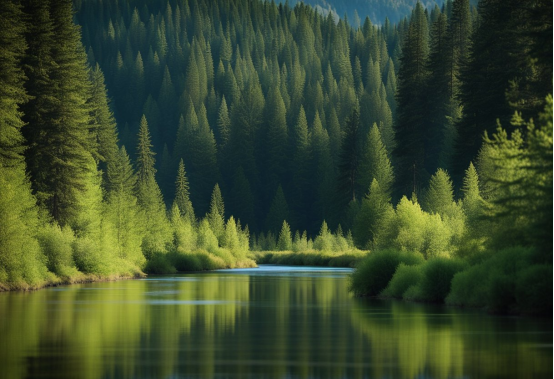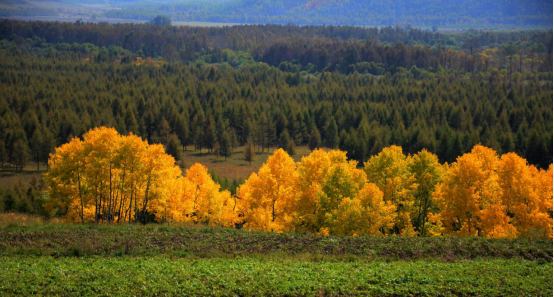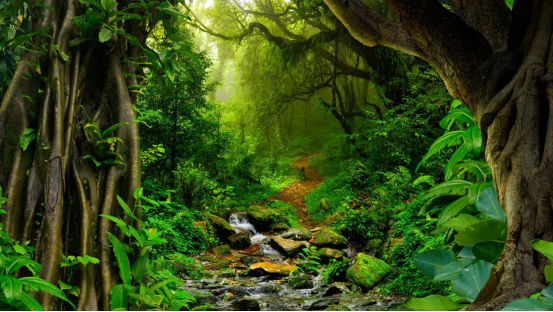
Redwoods teach people to look up, while Amazon teaches people to bow their heads. To bow your head to listen, to observe, to endure – this largest and most complex forest on earth has no order, no axis, but only density, complexity and undisciplined will of life.
Amazon is not the name of a forest, it is an ecological torrent. Here, trees are not the protagonists, they are just a node in the ecological chain. Animals, plants, fungi, water vapor, soil, all are entangled together, no one is higher than the other, and no one can escape. When you walk into here, you are not a tourist, but an intruder.
Live too much, die too soon
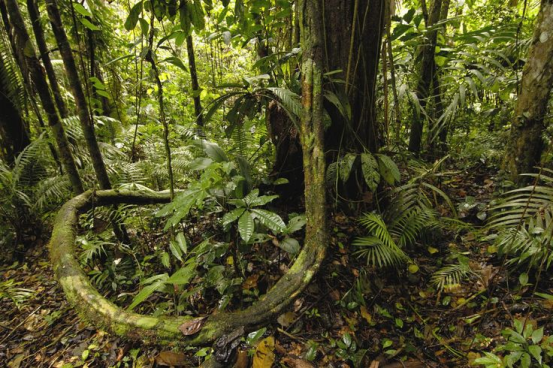
The density of the Amazon is oppressive. There are multiple layers of tree canopies overhead, making it difficult for sunlight to penetrate. Each layer has its own biological sovereignty: the top layer is made up of tall trees, the middle layer is made up of shrubs with vines, and the ground is wet and slippery, a world of mushrooms, insects, and rotten leaves.
You see a dense forest, but in fact most plants are struggling. They stretch upwards desperately, just to catch a ray of light. And once they fall, death is quickly processed: fungi start to work, termites swarm, and within a week, a tree can be reduced to soil.
Life here is not romantic, but a relay race. Every individual is a temporary data, and what is truly eternal is the system itself.
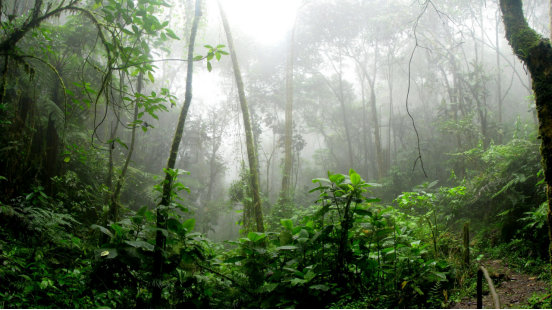
Where do the whispers come from?
Some say the Amazon whispers. That’s not an illusion, but a reality: the sounds here are never clean. You’ll hear vines rubbing in the wind, cicadas whistling through the air like chainsaws, monkey calls jumping overhead, and water flowing constantly underfoot.
There is no moment of silence, but there is no one voice that is the protagonist. They are interwoven into a web of background noise, enveloping you like a low-frequency spell. You begin to be suspicious, unsure of which sound comes from where, and not knowing which direction is the exit.
This forest does not welcome clarity, it uses chaos as its strategy.
Plants move, animals hide
The mystery of the Amazon does not come from imagination, but from what you can’t see. You know there are jaguars, cobras, poison dart frogs, sloths, and capybaras hiding in this forest, but they never show up on their own initiative. You are not “observing”, but being observed.
Even stranger are plants. Some vines will mimic the smell, color or leaf shape of other plants, just to better cling or avoid being eaten. Some trees will exude special sap to attract ants to protect themselves from other insects.
This is a smart forest, where every detail is full of calculations and instincts. You think you are walking into primitive nature, but in fact you are entering a sophisticated biological network.
Human maze
For indigenous tribes, the Amazon is not a “dense forest” but a map. They understand the whispers, know which bird song represents water, which tree bark can relieve pain, and which frog’s venom can be used for hunting. The rainforest is an extension of their body, an overlapping area of survival and faith.
For modern humans, the Amazon is a maze. GPS is not accurate, and compasses are easily confused. People cannot rely on logic here, but only on an ancient instinct: follow the humidity, listen to the sound, smell the smell, and slowly sense the direction with your footsteps. You have to be sensitive, otherwise you will be lost.
In conclusion: This is not paradise
Many people imagine the Amazon as a “natural paradise,” but the reality is far wilder than utopia. There is no human-centered aesthetic here, no paths, photo spots or audio guides prepared for you. It doesn’t even welcome you.
But it is precisely because of this that the Amazon has become the most precious green lung of the earth. It is not a resource “for us to use”, but a mechanism for the earth to maintain its own balance. When you stand in it, you will understand that you are just a decimal number in this complex formula.
Next time, we will go to the silence of the Bialowieza Forest in Poland . It is the only remaining lowland primeval forest in Europe, a forest where time has almost stopped, and a silent testimony to the true meaning of the “Lungs of Europe”.