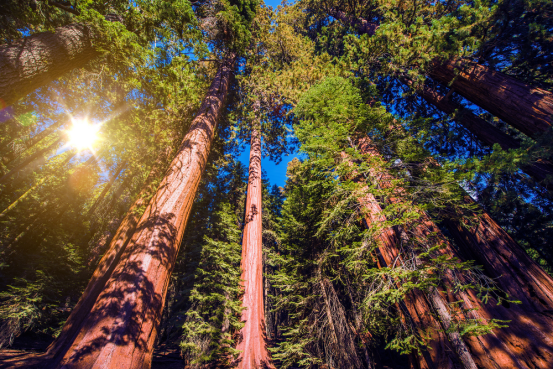
If Yakushima teaches us to be slow, then the redwood forest teaches us to look up. On the coastline of northern California, a stretch of forest stands like a group of silent giants, quietly reminding you that humans are not at the center of the scale.
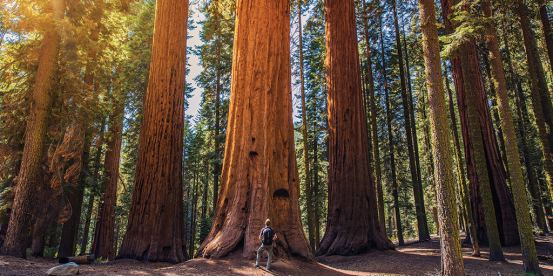
This is the tallest forest in the world – the coast redwoods (Sequoia sempervirens) can reach a height of 100 meters, nearly 30 meters higher than the Statue of Liberty. When you stand at their feet, your body will naturally lean back, as if facing something beyond language. They are not trees, they are pillars of time that soar into the sky.
“High” is not just about size
The height of the redwood forest is a state of mind. It is not for the purpose of climbing high and looking far, nor for showing off its greatness, but the result of patience evolved by nature. Here, time is measured in hundreds of years, and each annual ring is a response to wind, fire, moisture and drought.
The height of the redwood is not exaggerated. Its trunk is straight, not spiraling, not spreading, and not even particularly ostentatious. They just move upward slowly, firmly, vertically, and never impatiently. Because of this, they are so amazingly tall, yet reassuring.
The structure of silence
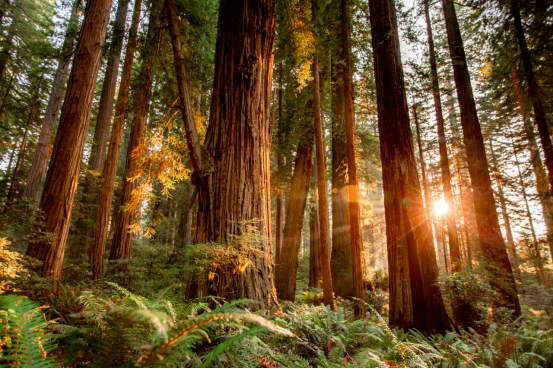
Walking into the redwood forest is like walking into some kind of huge building: colonnades, domes, skylights, everything is in order. The distance between trees is wide, the sunlight is filtered extremely softly, and there is a thick layer of fallen leaves underfoot, sometimes moss, sometimes fog. The sound is swallowed up, and even your own breathing becomes lighter.
Here, there is no noise of birds, only the occasional squirrel flying over the branches. And you become the most unnecessary element in the forest. The redwood will not look at you, nor will it fluctuate when you approach. Its existence is never for you, it does not need an audience.
Baptism of Fire, Memory of Trees
You may see some redwood trees with black spots of burnt flesh, which are their memories of fire. The ecology of redwood forests needs fire to renew: fire clears the ground, opens pine cones, and makes room for new life.
Many redwood trees are hollow, yet they have survived for thousands of years. They are like containers of memory, and the burnt holes are the traces of their struggle with time, not a defeat, but a proof. Here, injury does not mean death, and damage is even a necessary part.
The scale of people, the scale of trees
The redwood forest is not designed for humans. You can walk on the path in the forest, but it is only the occasional gap between the giant trees. You can’t see the top when you look up, and you can’t wrap your arms around a complete tree trunk. You begin to realize that humans have always claimed to be the center of the scale of all things – here, this belief is completely shattered.
Redwoods remind us: You can go far, but you may not grow tall. You can master many technologies, but you cannot make a redwood. You can cut it down, but you cannot replace it.
In conclusion: Standing is a kind of existence
Redwoods don’t speak, nor do they move. They just stand, standing for centuries. They have stood from ancient times to the present, and will continue to stand until the day when humans no longer use words to describe their height.
They are tall, but not proud; they are silent, but not indifferent. They are the pinnacle of existence – without the need for sound, just a straight line, they make people look up, feel awe, and contemplate.
Next stop, we will go to the whisper of the Amazon rainforest . It is not a straight height, but a tangled green, a hotbed where vitality and chaos coexist, and our first and most complex imagination of “jungle”.