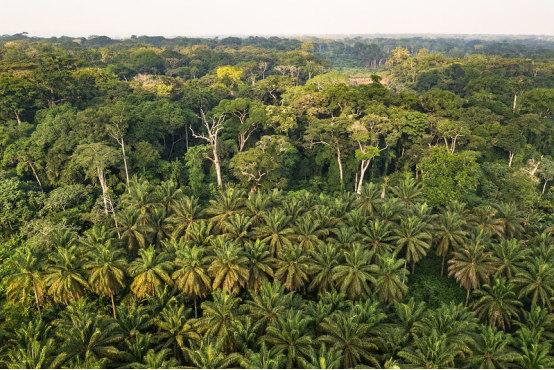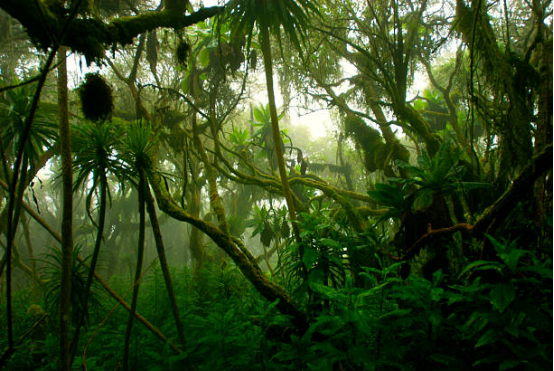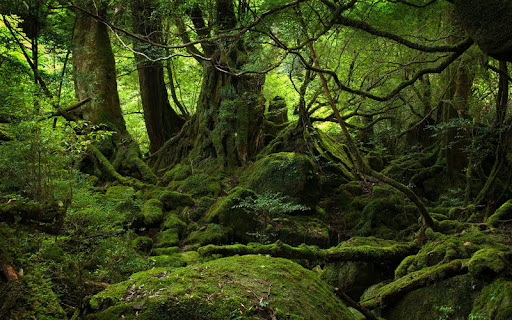
If the Congo rainforest is a deep breath, then Yakushima is a deep gaze. An island, a forest, a sense of silent time. The forest here is neither thick nor amazing, it just exists slowly and softly, as if all the plants are whispering, afraid of disturbing something older than humans.
In the forest of Yakushima, the first thing that enters your body is not the trees, not the sounds, but the “wetness”. The moist air is like an invisible woven cloth, covering your skin and slowly enveloping your senses. There is no need for language or purpose here, as long as you are willing to be quiet and wrapped by the moss of time.
Moss is the skin of time
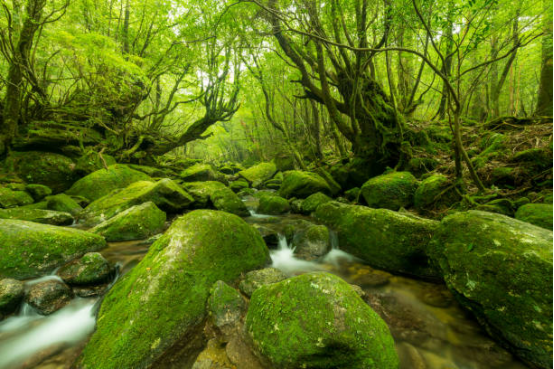
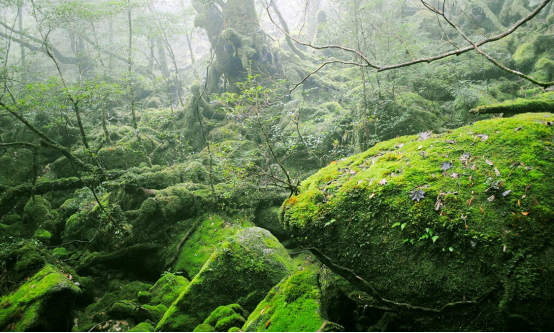
Walking along the forest trails in Yakushima, you will not notice the trees first, but the mosses on the ground. They do not compete for sunlight or height, but grow extremely slowly and are almost unnoticeable. But it is these green and soft mosses that constitute the “skin” of this forest.
They are attached to rocks, dead wood, and living trees, just like memories are attached to things, inseparable. When you step on them, they don’t protest or bounce back, but just gently accept you, letting you know: you are not a passer-by, but a part of the temporary residence here.
The Silent Watch of the Millennium Tree
Here is the famous “Jomon Sugi” which is more than 7,000 years old. It does not need humans to understand its age. Its annual rings are no longer a unit of time, but a slowly existing sediment.
In the forests of Yakushima, trees are not vertical living entities, but a consciousness that spreads in all directions. They have branches upward, roots downward, and moisture and moss-covered textures outward. Often, when a tree falls, its body becomes a new home for a dozen other plants. Here, there is no interval between death and rebirth.
The rhythm of rain is language
The rain in Yakushima is not the weather, but the norm. It does not come and go clearly, but permeates. In this forest, there are 300 rainy days a year, and the forest never complains. The rain here is not a disturbance, but an organization.
You can’t hear thunder, and you rarely see rainstorms. It just keeps falling slowly, sometimes like mist, sometimes like breathing. Rainwater here forms a rhythm, not interrupts it. You slowly realize that this forest remembers itself by being “wet.”
Walking on permitted paths
In the forests of Yakushima, some trails are man-made wooden plank roads. They are not meant to guide you where to go, but to remind you that you are allowed to get close to “partially”. This forest does not belong to humans, we are just borrowing it.
When you walk on these paths, you are not conquering any peaks or completing any journeys, but gradually dismantling the identity of a “traveler”. The slower you walk, the more you can hear the wet moss under your feet and see the tiny lichens on a stone slowly expanding.
In Yakushima, we learn to be “slow”
This forest will not give you a stunning scene for taking photos and checking in, but it will give you an extremely inner awareness – you begin to feel the “lengthening of time” and the “acceleration of your own rhythm”. But the forest never moves, it is always there, using its own slowness to teach you to rearrange the order of your senses.
You learn to speak in a low voice, learn to see the moss change color out of the corner of your eye, learn to wait for water drops to fall from the tip of a leaf before taking a step. You may even find yourself learning to “stop” here.
Last words: Soft weight
Yakushima is light. It is not as heavy as Congo, or even visually magnificent. But it has a soft weight and a quiet presence. Here, you will know what a “gentle but not weak” forest is.
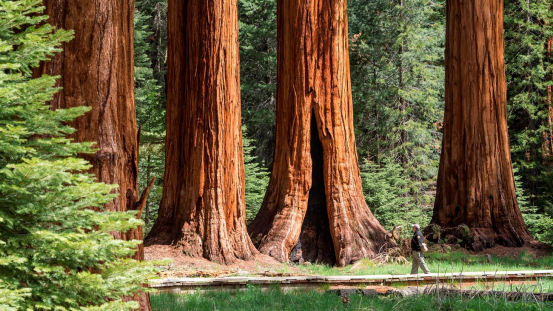
We walked from the breath of Congo to the silence of Yakushima. The next stop will take you to the height of the North American redwood forest . There, everything is vertical, with the will to grow upward and linear buildings reaching the clouds. We will try to use a new perspective to understand how a tree that is 100 meters high becomes a challenge to human scale.