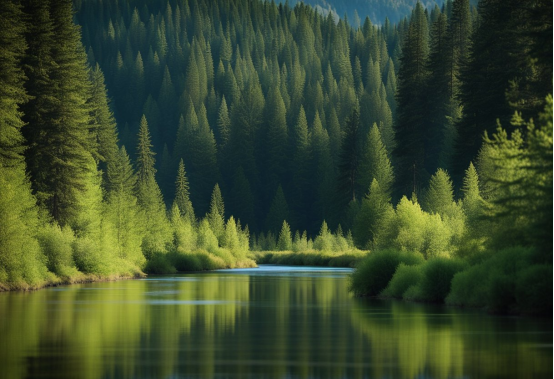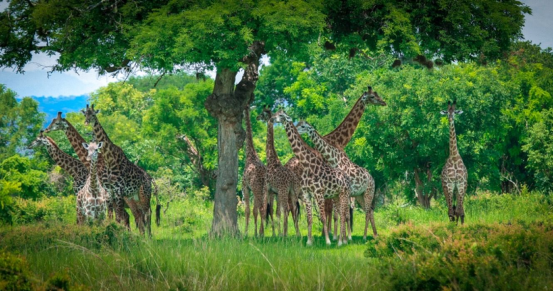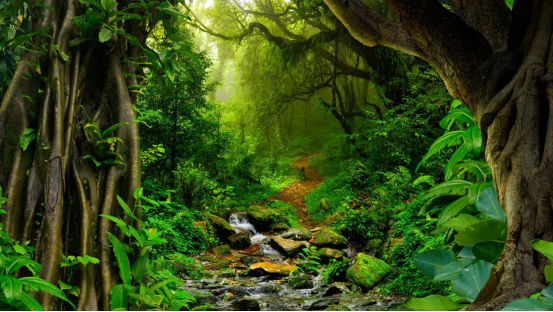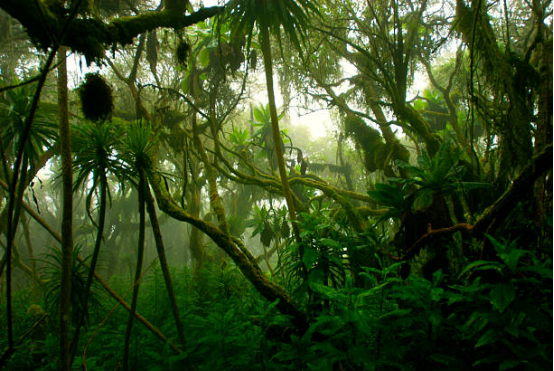
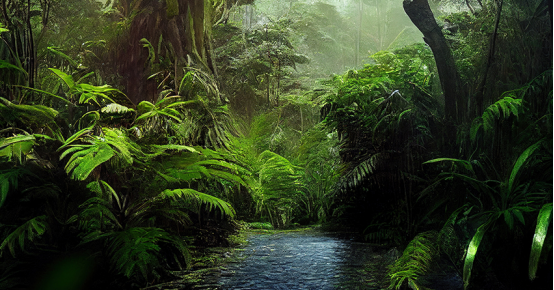
Some forests do not need wind to shake their branches and leaves. They breathe slowly and continuously. The Congo rainforest is one of these forests. It is neither eager to show nor keen to respond. It is silent, heavy, and enveloping, like a dark green blanket covering central Africa, isolating time and the hustle and bustle of the world.
You can’t “walk through” the Congo rainforest. It has no edges, only permeability. Every tree, every vine, is a continuation of a rhythm. It’s an inward-looking forest that refuses both linear paths and the perspective of the observer.
The pulse of the forest
If you stand in the heart of the Congo rainforest, really calm down, not move, not speak, not look for direction, you will hear a very low and slow rhythm, that is not the wind, nor the water, but the faint sound of the trees themselves flowing.
The Congo rainforest is not as well-known as the Amazon, but its heartbeat is deeper. It does not rush, it settles. It has no conspicuous totems, but it is older than myths. It is not a landscape for people to worship, but a growing skin that continues to breathe, never stopping.
No clear path, only encirclement
The Congo rainforest refuses linearity. It is not a forest that can be easily traversed, it is not a national park, nor is it an ecotourism area. It is more like a maze, a geography of moisture, a constant enveloping presence.
After you walk in, you can’t tell the directions. The light is broken into dust by the layers of leaves, and the sound becomes heavy in the humid air. The soil under your feet is not clean soil, but the remains of decayed, overlapping, and constantly regenerated plants, which is the proof of the repeated cycle of life in death.
It’s a sense of geography that’s more primal than direction. You don’t “browse” the forest so much as you’re slowly being swallowed by it.
The human state of silence
In the Congo rainforest, humans become very small. Not because of visual insignificance, but because of the collapse of perceptual structure: you can’t hear familiar voices, your phone has no signal, and language becomes redundant. You even forget the meaning of the word “forward”.
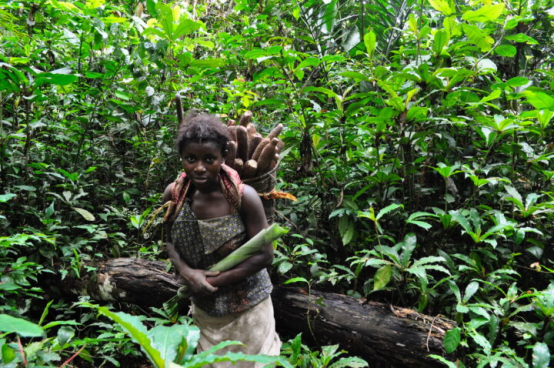
The local Mbuti people never “conquered” the rainforest, they just swam in it like fish in a river. They did not build permanent dwellings, but only made temporary shelters out of leaves and branches. There is no expression in their language for “owning” the forest, because in the Congo rainforest, any attempt to dominate will become futile.
The forest is not the background, it is the subject.
The rhythm of breathing
The Congo rainforest has its own unit of time, not minutes, not seasons, but the breath between “humidity changes.” You can feel that it rained in a certain area half an hour ago, and every particle in the air reveals the rhythm of the canopy dripping.
Sometimes you feel like the entire forest is holding its breath, with only vines and roots silently exchanging oxygen and information. The plants here seem to have the ability to communicate, using smells, colors, and weak vibrations to build a network that is older than any human Internet.
An existence that does not exist for humans
The Congo rainforest is not there for us. It does not need tourists, photographers, rescue plans or maps. It exists because it must, and it belongs to a scale greater than human history.
We just pass by occasionally and are changed by its rhythm.
In conclusion: a silent but clear green
The Congo rainforest teaches us that a forest is not a collection of trees, but a contrasting state of consciousness. Here, we step away from being the “protagonist” and learn to breathe, listen, and slow down.
The next forest will take us to the moss forest of Yakushima Island in Japan . There is no depth of Africa, but there is another kind of slow and soft time. If you are ready, we will turn from the green shadow of Congo and walk into the thousand-year-old forest on an island.