The Historical Evolution of Karesansui
The concept of Karesansui, or “dry landscape,” represents a pinnacle of Japanese aesthetic refinement. While often associated exclusively with Japanese culture, its roots are deeply intertwined with the ink wash painting traditions of China. The transition from the lush, water-dependent gardens of the Heian period to the minimalist, gravel-based designs of the Muromachi period reflects a seismic shift in spiritual and artistic priorities.
From Chinese Ink Wash to Japanese Gravel
Early Japanese garden design was heavily influenced by the Chinese landscape aesthetic, which emphasized the harmony between man and nature. However, as the Zen sect gained prominence in Japan, the physical garden evolved into a symbolic representation of the universe. The transition was not merely a change in materials, but a fundamental shift in the ontology of space.
- Chinese Influence: Focused on the naturalistic representation of mountains, rivers, and flora.
- Zen Adaptation: Replaced organic water features with sand and stone, forcing the observer to rely on internal imagery rather than external stimuli.

The Aesthetics of Dry Landscapes and Water Representation
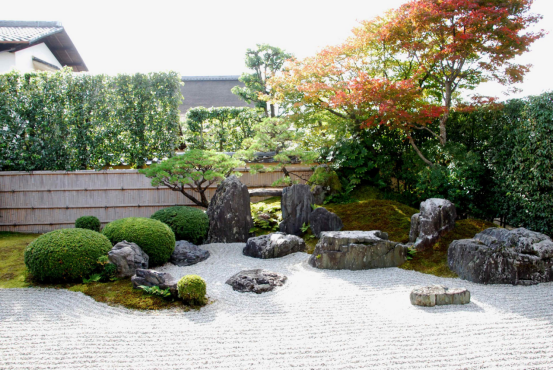
One of the most compelling aspects of Karesansui is its ability to evoke the dynamism of flowing water through static elements. This is achieved through the meticulous raking of gravel and the strategic placement of rocks, which serve as metaphors for currents, eddies, and waterfalls.
The Mechanism of Symbolic Flow
The absence of liquid water is not a limitation; it is an invitation for the viewer to participate in the act of creation. By staring at the patterns in the gravel, the mind projects movement onto a stationary surface, a process rooted in the principles of Zen meditation.
| Element | Symbolic Representation |
|---|---|
| Raked Gravel | Flowing water, waves, or clouds |
| Large Stones | Islands, mountains, or mythical beasts |
| Moss | Forests or distant plains |

Why Karesansui Gardens Are for Observation, Not Walking
Unlike Western gardens, which are often designed as recreational spaces for walking, Karesansui gardens are strictly observational environments. The architecture of these spaces is designed to frame a specific perspective, guiding the eye and the mind toward a state of stillness.
The Philosophy of the “Still Gaze”
The garden acts as a mirror for the soul. If one were to walk through the space, the physical presence of the viewer would disrupt the symbolic integrity of the landscape. By remaining stationary, the viewer transitions from a participant in physical space to a witness of spiritual space.
- Spatial Restriction: The gravel is meant to remain undisturbed, preserving the “water” patterns.
- Perspective Control: The garden is usually viewed from a raised veranda, creating a distance that fosters objective contemplation.

The Profound Influence of Zen on Garden Design
Zen Buddhism emphasizes the realization of enlightenment through direct experience and the stripping away of unnecessary ornamentation. In the context of garden design, this translates to minimalism and the use of natural, raw materials to highlight the impermanence of existence.
Principles of Zen Garden Architecture
The design of a Karesansui is governed by the principles of Wabi-Sabi—the appreciation of beauty in the imperfect, the impermanent, and the incomplete. Every rock and grain of sand is placed with an intent to facilitate a moment of clarity.
Frequently Asked Questions (FAQ)
- Q1: Why do Karesansui gardens use no real water?
- The absence of water is a deliberate design choice to foster meditative focus. By representing water through abstract patterns in gravel, the garden forces the observer to use their imagination, which is a key practice in Zen mindfulness.
- Q2: Can I walk through a traditional Zen garden?
- Generally, no. Most Karesansui gardens are designed to be viewed from a specific vantage point, such as a temple veranda. Walking through them would destroy the raked patterns that represent water and disrupt the meditative atmosphere.
- Q3: How does Zen philosophy influence the layout of these gardens?
- Zen influences the layout through principles of asymmetry, simplicity, and the removal of distractions. The garden is meant to strip away the chaos of the material world, leaving only the essential elements of nature to represent the cosmos.
- Q4: What is the significance of the rocks in a dry landscape?
- Rocks are considered the “bones” of the earth. In Karesansui, they represent mountains, islands, or even spiritual figures. Their placement is calculated to create a sense of balance and tension that grounds the entire composition.