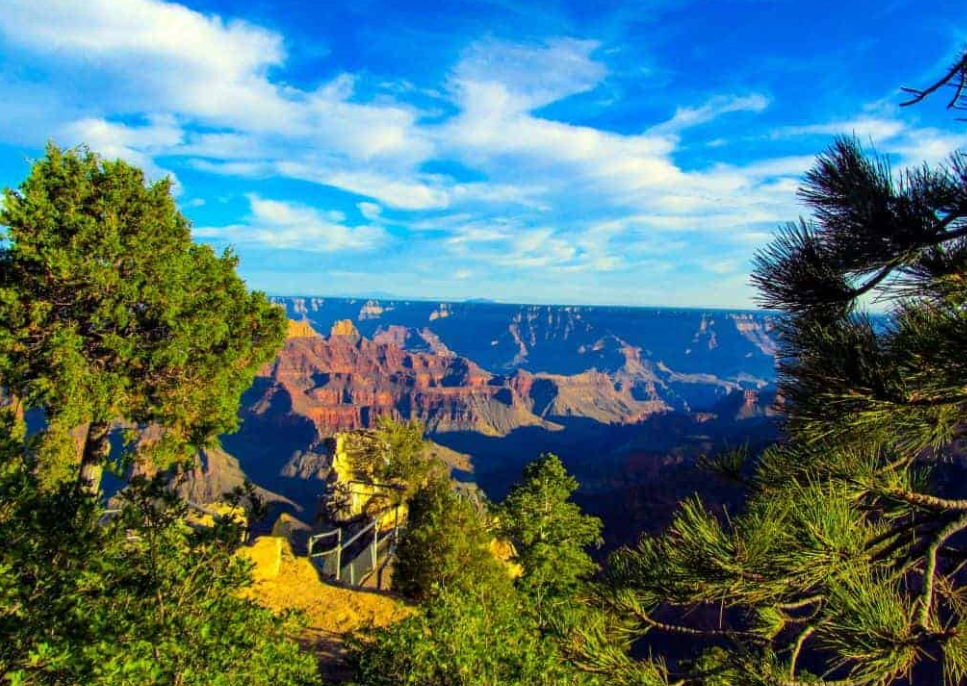
The Grand Canyon is more than just a breathtaking chasm; it’s a powerful geological force that has shaped life itself. This immense canyon acts as an impassable barrier, creating an isolated “sky island” on its North Rim known as the Kaibab Plateau. This high-elevation forest is a living laboratory of evolution, effectively a “prison” for the species that inhabit it, forcing them down a unique evolutionary path. This guide delves into the fascinating ecology of the Kaibab Plateau, explaining how this geographical wound in the earth created one of the most distinct ecosystems in North America.
What is the Kaibab Plateau? A Forest Above the Desert
The Kaibab Plateau is a large, elevated landform that constitutes the North Rim of the Grand Canyon. Rising to over 9,000 feet (2,740 meters) in elevation, it stands in stark contrast to the surrounding arid lowlands of the Great Basin and Colorado Plateau deserts. This significant elevation difference creates a unique, cooler, and wetter climate, allowing a dense forest of Ponderosa pine, spruce, fir, and aspen to thrive.
The “Sky Island” Phenomenon Explained
Ecologists refer to the Kaibab Plateau as a “sky island.” This term describes an isolated mountain range surrounded by a radically different lowland environment. The surrounding desert is like a “sea” that most forest-dwelling species cannot cross. This isolation prevents gene flow between populations on the sky island and those in other forested areas, leading to the development of unique subspecies and species over millennia. The Kaibab Plateau is one of the most striking examples of this phenomenon in the world.
Geological Context and Formation
The plateau itself is part of the larger Colorado Plateau uplift. Over millions of years, the entire region was lifted thousands of feet. Subsequently, the Colorado River began carving the Grand Canyon, a process that took 5 to 6 million years. As the canyon deepened and widened, it sliced through the Kaibab Plateau, effectively severing it from the South Rim and creating the profound isolation we see today.

The Great Divide: How the Canyon Forges Ecosystems
The Grand Canyon is the primary isolating mechanism for the Kaibab Plateau. While a bird can fly across the 10-mile (16 km) gap with ease, for a small, ground-dwelling mammal like a squirrel, it is an insurmountable obstacle. The sheer cliffs, the arid inner canyon, and the powerful Colorado River create a barrier that has been in place for millions of years, effectively splitting animal populations in two.
North Rim vs. South Rim: A Tale of Two Worlds
Though separated by only a few miles as the crow flies, the North and South Rims are ecologically distinct. The North Rim (Kaibab Plateau) is higher, cooler, and receives more precipitation, supporting a more robust and diverse forest ecosystem. The South Rim is lower, drier, and hosts a more arid-adapted forest of pinyon pine and juniper. This environmental difference, combined with the physical separation, has driven the evolution of different life forms on each rim.
The Role of the Surrounding Desert
While the canyon provides an east-west barrier, the hot, dry deserts surrounding the plateau to the north provide a secondary layer of isolation. This makes the Kaibab Plateau a true island of temperate forest in a vast sea of desert, trapping its inhabitants and magnifying the effects of genetic drift and natural selection.
Evolution in Action: The Tale of the Kaibab Squirrel
The most famous resident of this sky island is the Kaibab squirrel (Sciurus aberti kaibabensis). It provides one of the clearest and most-studied examples of evolution through geographic isolation. This unique squirrel is a subspecies of the Abert’s squirrel (Sciurus aberti), which is commonly found on the South Rim and in other Ponderosa pine forests of the Southwest.
A Classic Case of Allopatric Speciation
Before the Grand Canyon formed, a single, unified population of Abert’s squirrels likely lived across the entire region. As the canyon was carved, it split this population. The group isolated on the North Rim—the Kaibab Plateau—began to evolve independently. With no genetic input from the South Rim population, different traits became dominant, leading to the distinct subspecies we see today. This process is known as allopatric speciation, or evolution driven by geographic separation.
Comparison: Kaibab vs. Abert’s Squirrel
The differences between the two squirrel subspecies are striking and serve as a visual testament to their evolutionary divergence. While they share a dependence on the Ponderosa pine, their appearances have changed significantly.
| Feature | Abert’s Squirrel (South Rim) | Kaibab Squirrel (North Rim) |
|---|---|---|
| Belly Color | White | Dark gray to black |
| Tail | Primarily dark gray with a white outline | Conspicuously bright white |
| Body Color | Salt-and-pepper gray | Dark gray to brownish-black |
| Habitat | Ponderosa pine forests of the Southwest | Exclusively Ponderosa pine forests of the Kaibab Plateau |
Expert Advice for Visiting the Kaibab Plateau
Exploring the North Rim and the Kaibab National Forest is a rewarding experience, but it requires more planning than a visit to the more accessible South Rim. This unique environment presents its own set of challenges and opportunities.
Pro Tips for a Successful Trip
To make the most of your visit to this isolated wilderness, keep the following expert advice in mind. Proper preparation is key to safely enjoying the remote beauty of the North Rim.
- Plan for Seasonality: The North Rim is closed to vehicles from late fall to mid-May due to heavy snowfall. Always check the official National Park Service website for current road and facility status before you travel.
- Book Lodging Early: Accommodations on the North Rim are extremely limited and book up months, or even a year, in advance. If you plan to stay overnight, reserve your spot as early as possible.
- Fuel and Supplies: Services are scarce. Fill up your gas tank and stock up on food and water in Jacob Lake or Kanab before heading onto the plateau.
- Embrace the Remoteness: Cell service is spotty to non-existent. Download maps for offline use and inform someone of your travel plans. Enjoy the opportunity to disconnect.
- Wildlife Viewing Ethics: The Kaibab squirrel is a prime attraction. To view them and other wildlife, be patient and quiet. Never feed wild animals, as it harms their health and alters their natural behaviors. Use binoculars for a closer look without disturbing them.
Frequently Asked Questions (FAQ)
-
Why is the Kaibab Plateau called a “sky island”?
- It’s called a sky island because it is a high-elevation, forested mountain ecosystem completely surrounded by a “sea” of low-elevation desert. This isolation prevents forest-dwelling species from migrating to or from other similar habitats, just as an ocean prevents terrestrial species from leaving a conventional island.
-
Can you see the Kaibab squirrel on the South Rim of the Grand Canyon?
- No, you cannot. The Kaibab squirrel is found exclusively on the Kaibab Plateau (the North Rim). Its close relative, the Abert’s squirrel, inhabits the South Rim. The Grand Canyon itself acts as an impassable barrier that has kept the two populations separate for millennia.
-
Is the North Rim harder to visit than the South Rim?
- Yes, generally. The North Rim is more remote, has a much shorter operating season (mid-May to mid-October), and offers far fewer services and lodging options. It receives only about 10% of the visitors that the South Rim does, offering a wilder, less crowded experience.
-
What other unique wildlife is found on the Kaibab Plateau?
- Besides the Kaibab squirrel, the plateau is home to a diverse range of wildlife, including mule deer, pronghorn, coyotes, and a famous herd of “bison” (which are actually a hybrid of bison and cattle). The isolation has also influenced populations of insects and plants, though the squirrel is the most dramatic example.
Related Posts
Humanity Hypnotized by Waterfalls: The Sublime Beauty and the Fate of Rivers
A comprehensive exploration of the dual nature of waterfalls, analyzing the psychological attraction of the "sublime," the physical power of…
Andean Waru Waru: Unearthing Ancient Agricultural Secrets for Modern Resilience
This pillar page delves into the ingenious Waru Waru (camellones) agricultural system of the ancient Andes, revealing how its buried…
Fell Valley: The Ultimate Guide to Scotland’s Enchanting Elven Highlands
Embark on a profound journey through Fell Valley, a fabled "Home of the Elves" nestled deep within the Scottish Highlands.…