Discovering Northern Ireland’s Causeway Coastal Route
The Causeway Coastal Route is globally recognized as one of the most spectacular driving and hiking trails on the planet. Stretching from Belfast to Derry~Londonderry, this rugged coastline presents a mesmerizing tapestry of sheer cliffs, ancient geological formations, and centuries-old mythological heritage. For travelers seeking both intellectual enrichment and visceral thrills, two crown jewels stand out along this dramatic shoreline: the enigmatic Giant’s Causeway and the gravity-defying Carrick-a-Rede Rope Bridge. Understanding the unique interplay of natural history and human endeavor in this region is essential for any modern explorer.
As you traverse the winding roads of County Antrim, the landscape dramatically shifts from rolling green glens to imposing basaltic cliff faces. This geographical transition perfectly sets the stage for the awe-inspiring monuments ahead. The region is not merely a visual feast; it is a living museum of Earth’s volatile history and a testament to the resilience of the local communities who have navigated these treacherous waters for centuries.
The Magic of the Antrim Shoreline
The Antrim coastline is characterized by its dramatic weather patterns and shifting light, which continuously transform the visual aesthetic of the coastal cliffs. To fully appreciate this environment, one must understand the distinct elements that make the Causeway Coast an unparalleled destination.
- Geological Diversity: The coastline features a unique combination of white chalk cliffs juxtaposed against dark, hexagonal basalt columns, creating striking visual contrasts that photographers and geologists alike find irresistible.
- Atmospheric Conditions: The frequent transition from mist to brilliant sunshine adds a layer of mystique to the landscape, often enhancing the storytelling aspect of the local myths.
- Ecological Richness: Beyond the rocks, the coastal route is a haven for biodiversity, hosting rare seabird colonies and unique maritime flora that thrive in the salty, wind-swept environment.
These foundational elements create a multi-sensory experience. The roaring Atlantic Ocean crashing against the ancient rocks provides a constant acoustic backdrop, ensuring that every step taken along the cliff paths is accompanied by the raw power of nature.

The Geological Marvel of Giant’s Causeway
At the heart of Northern Ireland’s coastal allure lies the Giant’s Causeway, a UNESCO World Heritage site comprising approximately 40,000 interlocking basalt columns. To stand upon these stepping stones is to stand on the remnants of a cataclysmic era in Earth’s history. The sheer mathematical precision of the hexagonal pillars often leads visitors to question whether they are man-made, but the truth is rooted in complex volcanic activity that occurred over 60 million years ago during the Paleogene Period.
The formation of the Causeway is a masterclass in thermodynamics and geological cooling processes. Understanding the science behind the stones deepens the appreciation for this natural wonder, transforming a simple sightseeing visit into an educational expedition.
Volcanic Origins and the Science of Cooling
During the early Paleogene period, the region that is now County Antrim was subject to intense volcanic activity. Highly fluid molten basalt intruded through chalk beds to form an extensive lava plateau. As this lava met the cool air and water, a fascinating physical process unfolded.
The rapid cooling of the lava caused it to contract. While contraction in cooling materials usually results in random fracturing, the uniform composition of the basalt and the specific rate of cooling here led to a highly regular pattern of cracking. The fractures propagated downward as the mass cooled, creating long, geometric columns. Most of these columns are hexagonal, though some possess four, five, seven, or even eight sides. The tallest columns reach up to nearly 12 meters (39 feet) in height, while the solidified lava in the cliffs reaches an astonishing 28 meters thick in some places.

The Mythic Tale of Finn MacCool and the Basalt Ladder
While science provides the structural explanation for the Giant’s Causeway, local folklore offers a narrative that is arguably much more captivating. In Irish mythology, the causeway was not forged by fire and cooling rock, but by the hands of the legendary giant, Fionn mac Cumhaill (anglicized as Finn MacCool). This mythic tale of the “basalt ladder to heaven” has been passed down through generations, weaving a rich cultural fabric that is inextricably linked to the physical landscape.
The legend serves as a cultural bridge, connecting the people of Northern Ireland to their Celtic roots. It explains the unexplainable through the lens of heroism, rivalry, and cunning intellect, providing a deeply human context to an otherwise sterile geological phenomenon.
The Rivalry with Benandonner
According to the most popular iteration of the myth, Finn MacCool was challenged to a fight by the Scottish giant Benandonner. To bridge the gap across the North Channel and meet his foe, Finn built the causeway across the sea. However, upon seeing the sheer, terrifying size of Benandonner approaching from Scotland, Finn realized he was vastly outmatched.
Fleeing back to Ireland, Finn enlisted the help of his clever wife, Oonagh. She disguised the massive Finn as a baby, tucking him into an oversized cradle. When Benandonner arrived and saw the size of the “infant,” he was struck with terror, reasoning that if the child was this colossal, the father must be truly monstrous. Benandonner fled back to Scotland in a panic, tearing up the causeway behind him to prevent Finn from following. This delightful myth perfectly explains why identical basalt columns are found across the sea at Fingal’s Cave on the Scottish isle of Staffa.

Conquering the Carrick-a-Rede Rope Bridge
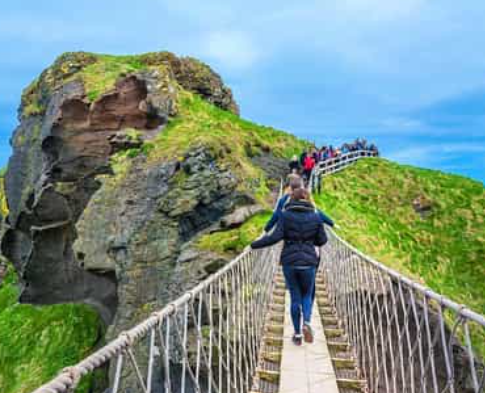
A short drive from the Giant’s Causeway lies an entirely different kind of coastal marvel: the Carrick-a-Rede Rope Bridge. Suspended nearly 30 meters (100 feet) above the churning Atlantic Ocean, this seemingly fragile link of rope and wooden planks connects the mainland to the tiny, craggy island of Carrickarede (from the Irish ‘Carraig a’ Ráid’, meaning ‘rock of the casting’). Crossing the bridge is a rite of passage for visitors, offering an adrenaline-inducing experience coupled with unparalleled panoramic views.
The bridge represents a profound intersection of human necessity and natural extremity. It is not merely a tourist attraction, but a historic artifact that tells the story of the region’s industrial past and the extraordinary lengths to which locals would go to secure their livelihoods.
The Crossing Experience: What to Expect
Approaching the bridge involves a scenic 1-kilometer coastal walk from the parking area, which builds anticipation as the sheer drop of the cliffs comes into view. Once at the bridge, the reality of the crossing sets in. The structure spans a 20-meter chasm, and while it is entirely safe and maintained by the National Trust, the distinct sway of the ropes in the coastal wind provides a genuine thrill.
- The Descent: Visitors must navigate steep, uneven stone steps to reach the bridge’s anchoring point, requiring sturdy footwear and a reasonable level of physical fitness.
- The Suspension: Stepping onto the wooden slats, you will feel the bridge move underfoot. Looking down reveals crystal-clear, turquoise waters and jagged rocks 30 meters below.
- The Island: Once across, Carrickarede island offers a serene, isolated vantage point. It is an excellent spot for birdwatching and looking out toward Rathlin Island and the Scottish coast on clear days.
The return journey requires crossing the bridge a second time, often feeling slightly easier as visitors become accustomed to the sway and rhythm of the suspension structure.

The History of the Salmon Fishermen
To fully appreciate the Carrick-a-Rede Rope Bridge, one must delve into its origins. The bridge was not erected for thrill-seekers; it was a highly practical, albeit perilous, tool created by local salmon fishermen in 1755. For over 250 years, this precarious crossing was essential for intercepting the migrating Atlantic salmon that navigated the waters around the island.
The historical context of the bridge transforms the crossing from a simple physical challenge into a walk through history. It prompts a deep respect for the fishermen who braved these conditions daily, often carrying heavy loads of fish and equipment across a bridge that, in its original form, had only a single handrail and widely spaced slats.
The Evolution of the Bridge
The design and safety of the Carrick-a-Rede bridge have evolved significantly since the 18th century. In its earliest iterations, the bridge was a terrifying prospect, constructed of rudimentary ropes and sparse wooden planks. Fishermen would cross it carrying massive nets and the day’s catch, relying entirely on balance and nerve.
By the 1970s, the bridge still featured a single handrail, making it a daunting task for even the bravest locals. It wasn’t until the year 2000 that a modern, fully enclosed rope bridge was installed to safely accommodate the growing influx of tourists. Today’s bridge, constructed of high-tensile wire rope and robust Douglas fir planks, is tested to withstand extreme weights and gale-force winds, ensuring safety without entirely stripping away the visceral thrill of the crossing.

Wildlife and Nature Along the Coastal Cliffs
Beyond the geological and historical landmarks, the Causeway Coastal Route is a thriving ecosystem. The imposing cliffs, hidden caves, and nutrient-rich waters create a sanctuary for a diverse array of wildlife. Nature enthusiasts traversing the route between the Giant’s Causeway and Carrick-a-Rede will find themselves immersed in a vibrant, living landscape that requires careful observation to fully appreciate.
The juxtaposition of the harsh, windswept environment with the delicate balance of life it supports is a profound aspect of the Northern Irish coast. From the skies above to the depths below, the region is teeming with species that have adapted to this rugged terrain.
Avian Life and Marine Mammals
The sheer cliff faces around Carrick-a-Rede and the Causeway are premier locations for ornithologists and casual bird watchers alike. The isolation of the coastal rocks provides perfect nesting grounds, safe from land-based predators.
- Seabird Colonies: The cliffs are home to breeding pairs of Fulmars, Kittiwakes, Guillemots, and Razorbills. Their synchronized diving and soaring add dynamic movement to the static cliff faces.
- Marine Life: Looking down into the clear waters, visitors frequently spot grey seals bobbing in the surf. On calmer days, pods of bottlenose dolphins and even basking sharks can be seen migrating along the coast.
- Coastal Flora: The cliff tops are blanketed in specialized maritime vegetation, including sea pinks (thrift), sea campion, and spring squill, which paint the green landscape with vibrant hues during the blooming seasons.
Protecting this fragile ecosystem is a priority for local conservation groups, and visitors are strictly urged to stay on designated paths to avoid disturbing nesting sites and delicate plant life.

Planning Your Itinerary: Transportation and Logistics
Executing a flawless trip to the Causeway Coast requires meticulous planning. While the distance between major attractions like the Giant’s Causeway and Carrick-a-Rede is relatively short (approximately a 15-minute drive), navigating the narrow coastal roads, managing peak tourist hours, and securing entry tickets demand strategic foresight. A well-planned itinerary ensures that you spend your time absorbing the majestic views rather than waiting in lines or battling traffic.
Whether you choose to rent a vehicle for maximum flexibility or rely on the extensive network of guided tours and public transport, understanding the logistical landscape is the key to unlocking the full potential of your Northern Ireland adventure.
Comparing the Attractions for Optimal Scheduling
To help structure your day, it is highly beneficial to understand the operational differences between the two main sites. Below is a comparative breakdown to assist in your logistical planning:
| Feature | Giant’s Causeway | Carrick-a-Rede Rope Bridge |
|---|---|---|
| Access & Ticketing | Site is free; Visitor Centre requires a paid ticket. | Strictly ticketed; pre-booking online is mandatory. |
| Time Required | 2 to 3 hours for thorough exploration. | 1.5 to 2 hours including the coastal walk. |
| Physical Demand | Moderate (steep hills, uneven rocks). | Moderate to High (steep steps, heights). |
| Best Time to Visit | Early morning or late evening for photography. | Mid-morning to avoid high winds later in the day. |
By leveraging this comparative data, travelers can strategically book their Carrick-a-Rede crossing for the morning when winds are generally calmer, followed by a leisurely afternoon exploring the expansive grounds of the Giant’s Causeway as the sun begins to set.

Safety and Weather Tips for Coastal Explorers
The beauty of the Northern Irish coast is inextricably linked to its wild, untamed weather. The Atlantic weather systems can be highly unpredictable, with conditions shifting rapidly from clear skies to driving rain and gale-force winds within an hour. Proper preparation is not just a matter of comfort; it is a critical component of personal safety when navigating cliff-edge paths and slippery basalt columns.
Respecting the environment means acknowledging its power. The coastline is exposed to the full force of the ocean, and visitors must dress intelligently and remain vigilant to environmental changes to ensure a secure and enjoyable experience.
Dressing for the Elements
The golden rule for exploring the Causeway Coast is layering. Because you will be transitioning between strenuous walking and standing still to admire the views, your body temperature will fluctuate. Furthermore, the wind chill on the cliffs can significantly lower the perceived temperature.
- Base Layers: Moisture-wicking fabrics are essential to keep sweat away from the skin during the steep climbs back from the Causeway or the Rope Bridge.
- Insulation and Waterproofing: A high-quality, windproof, and waterproof outer shell is non-negotiable. Umbrellas are entirely useless and actively dangerous in the high coastal winds.
- Footwear: The basalt columns at the Causeway are notoriously slippery when wet. Sturdy, waterproof hiking boots with aggressive ankle support and deep-tread soles are required. Avoid flat-soled sneakers or sandals at all costs.
Additionally, always check the local weather forecasts before setting out. In the event of severe high winds, the National Trust will proactively close the Carrick-a-Rede Rope Bridge for safety reasons, so having a flexible itinerary is highly recommended.

Sustainable Tourism and Preserving Northern Ireland’s Heritage
As the global popularity of the Causeway Coastal Route surges—partially fueled by its appearance in major television and film productions—the strain on the local infrastructure and delicate natural ecosystems has intensified. Sustainable tourism is no longer a buzzword; it is an absolute necessity to ensure that the Giant’s Causeway and Carrick-a-Rede remain intact for future generations to explore and study.
Visitors play a crucial role in conservation efforts. By making conscious choices about how they travel, where they spend their money, and how they interact with the landscape, tourists can become active participants in the preservation of Northern Ireland’s most treasured heritage sites.
Actionable Steps for the Responsible Traveler
Engaging in sustainable tourism along the coast requires a mindful approach to everyday travel decisions. The National Trust, which manages both sites, relies heavily on the cooperation of the public to maintain the pristine condition of these areas.
First and foremost, adhere strictly to the “Leave No Trace” principles. The coastal winds can easily snatch loose wrappers or plastics, carrying them directly into the ocean where they pose a lethal threat to marine life. Always carry your refuse until you find a designated recycling bin. Secondly, respect the physical boundaries set by conservationists. Walking off the designated paths at the Causeway or Carrick-a-Rede accelerates soil erosion and destroys the fragile root systems of rare coastal plants. Finally, consider utilizing public transportation, such as the Causeway Rambler bus service, which significantly reduces carbon emissions and alleviates the severe parking congestion that plagues the narrow coastal roads during the summer months.
Frequently Asked Questions (FAQ)
- Is the Carrick-a-Rede Rope Bridge safe to cross?
- Yes, it is exceptionally safe. The modern bridge is constructed with high-tensile steel wire and sturdy Douglas fir wood. It is strictly maintained and regularly inspected by the National Trust. The bridge will be closed immediately if wind speeds reach dangerous levels.
- Do I need to pay to see the Giant’s Causeway?
- Access to the geological site itself (the stones) is technically free via the public right of way. However, utilizing the on-site parking, accessing the interactive Visitor Centre, and using the guided audio tours requires purchasing a Visitor Experience ticket.
- How long does it take to walk between the two sites?
- While they are only a 15-minute drive apart, walking between the Giant’s Causeway and Carrick-a-Rede via the coastal path is approximately 16 kilometers (10 miles) and takes about 4 to 5 hours. It is a stunning hike for those with the time and physical stamina.
- Can children cross the rope bridge?
- Yes, children are permitted to cross the bridge, provided they are capable of walking independently. For safety reasons, babies and toddlers cannot be carried across in arms or in standard carriers. Parents must use their discretion regarding their child’s comfort